Category: Uncategorized

  • The Imperative of Sanity, Compassion, and Moral Responsibility in Leadership

    The Imperative of Sanity, Compassion, and Moral Responsibility in Leadership

    Sanity and Responsibility in Global Leadership

    Effective leadership at the national level demands sanity and psychological stability. Leaders should be required to pass psychiatric evaluations to ensure they possess the necessary temperament and are not driven by megalomania. The consequences of placing an unstable individual at the helm are grave; the actions of one can bring suffering to countless others.

    Hidden Dangers and Global Unrest

    There is a pervasive sense that much transpires behind closed doors, concealed from public scrutiny. The world stands on a precipice, threatened not by natural disaster but by events engineered and intended by human hands. In this climate of widespread violence, anxiety grows and people are quick to react impulsively, when patience and discernment are most needed.

    Shifting Values and Social Tensions

    Long-held beliefs are eroding as cruelty gains traction in society. Now, more than ever, patience, tolerance, compassion, and kindness must be cultivated. Unfortunately, the media often amplifies stories of intolerance and harshness, overshadowing acts of empathy and goodwill.

    Superpowers and the Threat of Catastrophic Weaponry

    Numerous superpowers possess nuclear and biological weapons, and the fate of civilization rests in the hands of those who control them. When did society begin to prioritize individual desires over the fundamental right to life, regardless of the impact on others?

    The Necessity for Moral Integrity in Leadership

    Leaders must act with sound judgment and avoid inciting violence, especially in societies marked by religious differences. In the last seventy years, loss of life has exceeded that of the previous two millennia, as nations take pride in their destructive capabilities. But pride in armament raises profound questions: is there honour in genocide, in the annihilation of a people, a culture, or a belief system, often for mere resources and wealth?

    Calling for Change

    Lives are sacrificed to greed. Who will declare, “Enough”? When will humanity, as a whole, declare “Enough”? The sacredness of life, the value of family, the compassion of strangers, the kindness of others—these should guide us, rather than cruelty and sensationalism.

    The Cost of Freedom and the Question of Morality

    With freedoms come sacrifices: bloodshed, filled graves, and the deaths of innocents to satisfy vengeance and greed. Has the world lost its moral compass, forgotten the importance of conscience, and failed to ask, “Is this pleasing to a higher power?” Reflection on this question can guide actions toward goodness.

    Restoring Compassion and Hope

    A heart motivated by love and compassion stands in opposition to one consumed by hatred and vengeance; time will reveal which prevails. Encouragingly, many individuals are stepping forward to help others, giving hope for the future.

    The Role of Children in Shaping the Future

    Children are increasingly involved in making positive change. By teaching them to value life, kindness, compassion, mercy, and integrity, we give the world a greater chance at survival. In their formative years, young minds remain untainted and capable of innovative thinking. When we consider all children as ours, we foster a community where every child is cared for and empowered to realize their potential.

    Note: “AI-assisted editing was used in the preparation of this document.”

  • The Power and Purpose of “What If?”

    The Power and Purpose of “What If?”

    The Dual Nature of “What If?”

    The question “What if?” holds remarkable power. It can evoke hope for what lies ahead, but just as easily, it can stir anxiety about the unknown. More often than not, when people ask “what if,” they are not hoping for the best but are bracing themselves against uncertainty. This question naturally triggers a protective instinct—safeguarding one’s self, one’s belongings, and one’s rights.

    Exploring Failure and Possibility

    At its core, “What if?” is a question that pierces through fear and ventures into the unknown. When reflecting on past events or perceived failures, this question helps us imagine what might have been or could have been. More importantly, it becomes vital when planning for the future—considering what could be and what will be. After experiencing failure, “What if?” encourages us to consider new approaches and alternative paths to reach our goals. It prompts us to open our minds to a range of scenarios, though we often dwell on what might go wrong. However, recognizing what doesn’t work is simply an opportunity to try again, and it is this willingness to persist after failure that paves the way toward true excellence.

    The Transformative Power of Perspective

    Time and again, I find myself pondering:

    • What if people chose to love and respect each other, regardless of their differences? How might the world transform?
    • What if we put aside our disagreements, even briefly, to truly listen and understand one another? Would conflict and war persist?
    • What if, when faced with anger, we paused to breathe and responded with patience, compassion, and understanding rather than reacting in haste?

    The “What if?” question, then, is not only a tool for self-protection and reflection—it is also a call to envision a better future, learn from what has not worked, and strive for greater empathy and excellence.

    Featured image: 6 Words for When You’re Not Sure | Merriam-Webster

  • Beyond the Obstacles

    Beyond the Obstacles

    Choosing to be Kind

    I woke up from the dream with the thought that if the world continues on in the vein it is currently in, then there would be no hope for mankind. 

    My mind percolated with thoughts and a knowing that if people began to act in a way that benefited all people, and not solely themselves, the world would soon change for the better. 

    Prevalent in the dream vision was man helping man simply because they could, without expecting anything in return – just simply because it was within their ability to do so – not for gain, not for gratification – just for the sake of helping another human being.  The kindness did not have to be a grand gesture; sometimes a small one is more than amply sufficient and helps for that moment in time.

    When we begin to see all of mankind as our brothers and our sisters and recognize that the children of the world belong to all of us for, they are this world`s future, then the world will be a much kinder place.

    We know that if our family members the ones in need of help, we would step in and do so without a second thought (most of us that is) and we would hope, if we aren`t available or near, that someone else would step in to help them – and this too is how we must perceive others in the world. 

    If we continue to view our actions with the “what’s in it for me” frame of mind, we all suffer.

    Random acts of kindness, compassion, mercy, and integrity are what are required.  Were we all to see ourselves from the eyes of those looking at us, we may be surprised by what we find there.

    Cultivate a nature of kindness, compassion, mercy, and integrity not only to help yourself, but to help others as well.

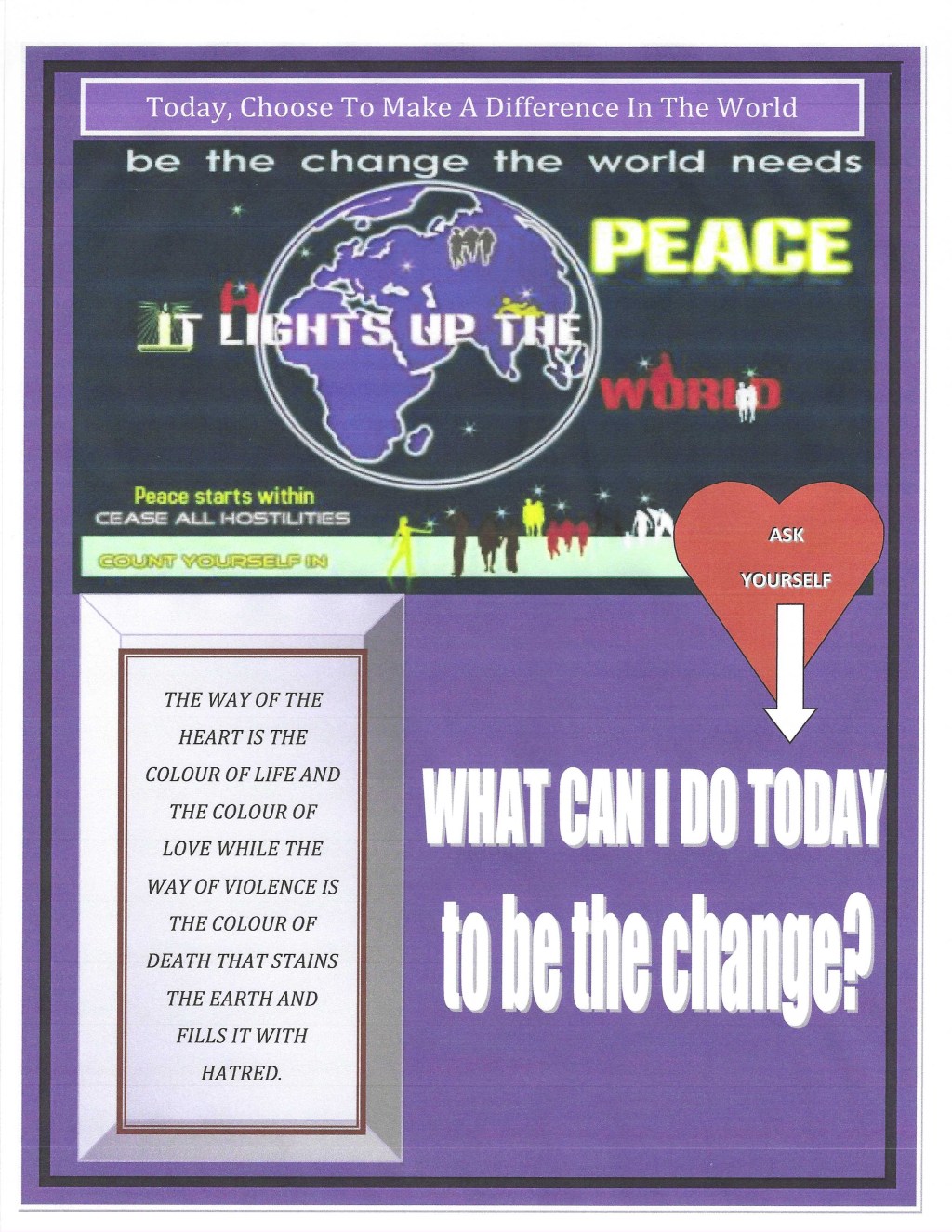
    Make a difference in the world today! Be the change you want to see in the world. Change begins with us.